Showing posts with label Photography. Show all posts

Sunday, 23 February 2014

'When Harmony Went to Hell'


I thought I’d resurrect my long-lost blog with some musings from the current Rivington Place exhibition: When Harmony went to Hell.


An exhibition of two parts, we are first invited to understand the DRC through the work of contemporary Congolese photographer, Sammi Baloji.
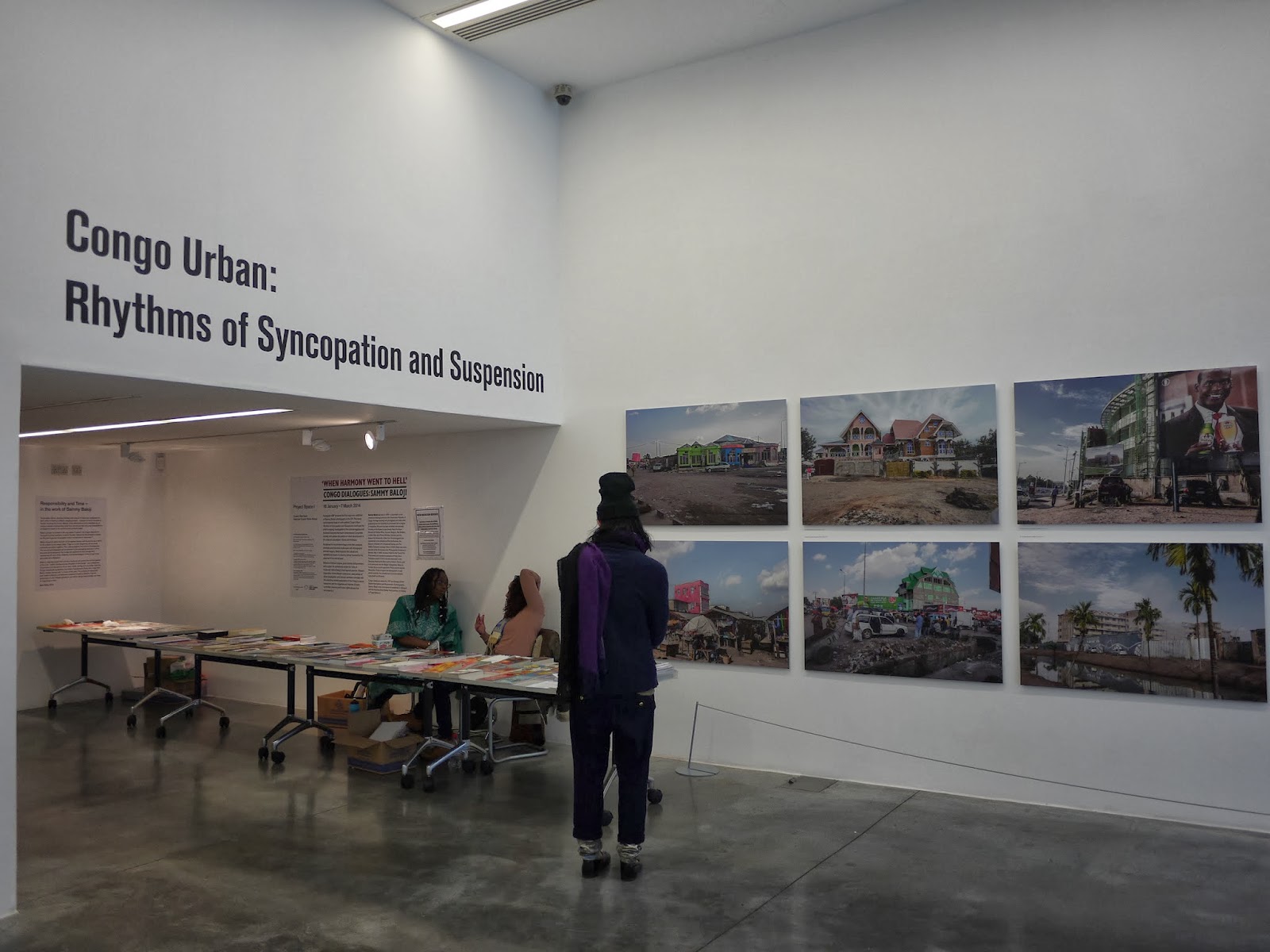

In the quest to ensure that history is not erased by the promises of modernisation and progress, Baloji’s photography, film and montage work explores his native country’s colonial past and political present.


Foucault’s theories of power and repression are referenced in relation to Baloji’s work, his images, in particular his montages, serve as an excellent transition to the photographs and writings of Alice Seeley Harris from the early 1900’s.


An active member of Anti-Slavery International, Seeley Harris’ photographs and first-hand accounts from lectures at the Congo ReformAssociation, resulted in public outcry across Europe and America.


Cited as the first example of campaign photography, Seeley Harris’ work exposed the dire conditions of Congolese slaves under an oppressive and violent regime and are hailed as instrumental to the eventual demise of King Leopold II’s reign over the Congo in 1908.


Her accounts of the exploitative rubber and ivory industries can be compared to those of the extractive industries in developing countries today and begs the question: How we can ensure that the Hobbesian notions of the human condition do not prevail in the 21st Century?


A chance to see rarely exhibited works of great historical importance, this is a must see exhibition.

London
EC2A 3BA
16 Jan – 7 March 2014


Sunday, 12 February 2012

The world according to Diane Arbus...

Diane Arbus's photography is well known for being direct and powerful, her work is associated with images of those in the margins of society: subcultures consisting of 'freaks', 'outsiders' and other 'undesirables'.  Often framed in the centre of the photograph, close-up and with the subject posing with a confident gaze towards the viewer, an uncomfortable intimacy is created between them, the subjects, and us, the viewers.  

Diane Arbus was an interpreter, her photographic style allowed the subjects to stand up to the viewers, demand us what we think, challenge us to judge, and ultimately, let us know that they don't care for our thoughts.  For this reason the Jeu de Paume, in Arbus's first major retrospective in France, laid bare the images - accompanied only by their original names - to confront the viewer in a way unique to each.

We, as viewers, are not being asked to identify with the suffering, we are not asked to be compassionate, as in journalistic photography for example.  Neither those photographed, or the photographer ask this of the viewer, we are just asked simply to look.

Identical Twins.  Roselle, New Jersey 1967
Tattooed Man at a Carnival.  1970
A Young Man in Curlers at Home on West 20th Street. 1966. 
Child with a Hand Grenade in Central Park.  New York 1962
Naked Man Being a Women.  New York. 1968.

Susan Sontag notes in 'On Photography' that the authority of Arbus's work is largely due to the fact that each of her subjects has posed for her and creating a 'straight-on, contemplative portrait'; rather than a stolen-snap taken in voyeuristic fashion.  The fact that Arbus's 'freaks' are willing to be photographed also leads Sontag to question their own perceptions of self 'Do they see themselves, the viewer wonders, like that?...Arbus photographs people in various degrees of unconscious or unaware relation to their pain, their ugliness'.

Untitled, 1970 & 1971

In the two years leading up to her suicide, Diane Arbus spent much time photographing people with learning difficulties.  It is in these photographs where I see a real joie de vivre.  All the photographs in this period are Untitled and it left me wondering if this was perhaps because she was unable, or unwilling, to define these subjects in the same way as the others.  

In her own words, 'a photograph is a secret about a secret.  The more it tells you the less you know'.


Diane Arbus


I absolutely love this self-portrait of Arbus pregnant, her cocked head seems to be subtly questioning her own image, freakishness and pain in the same way as her photographs do of others.  It proves that she is not afraid to turn the cameras eye, with its capacity to both capture and distort reality, on herself.